Real-Time Analytics for iGaming Operators: The Data Advantage
Editorial
Why data infrastructure is becoming a strategic advantage in iGaming
Is your data infrastructure a constraint on your business? For many iGaming operators, slow query performance and high storage costs have quietly defined the limits of what they can offer players, affiliates, and internal teams.
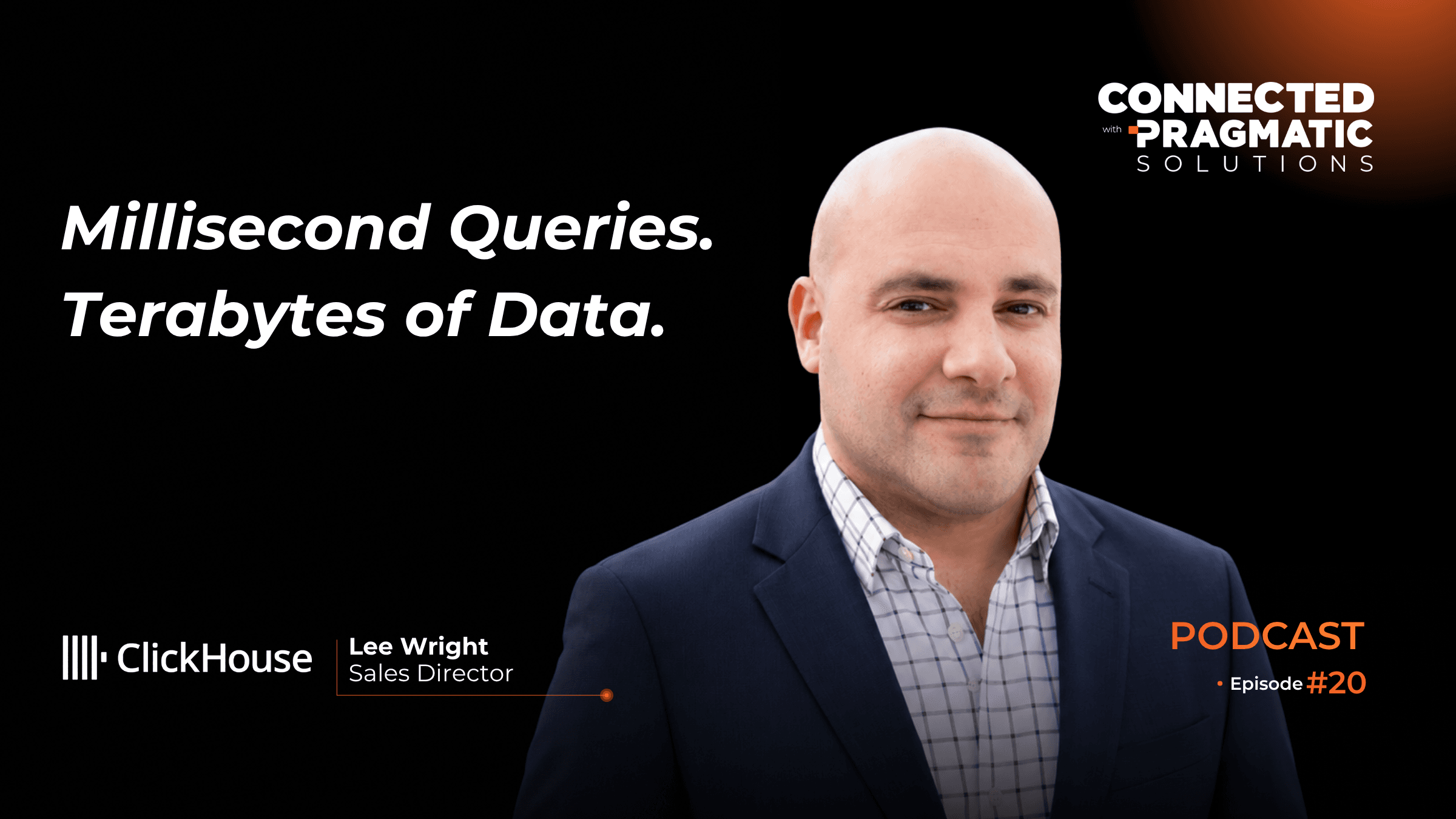
In Episode 20 of the Connected with Pragmatic Solutions podcast, our CEO, Ashley Lang, speaks with Lee Wright, Sales Director at ClickHouse, about the architecture behind one of the fastest-growing analytical databases in the world, and why iGaming operators are increasingly adopting it as a foundational layer in their tech stack.
The cost problem nobody talks about loudly enough
Most iGaming operators are sitting on far more data than they can practically use. Their bottleneck is the cost and latency of querying it. Running complex analytical queries across player activity, affiliate campaigns, payments, and game performance on conventional databases is either too slow, too expensive, or both.
ClickHouse is a column-oriented OLAP database built specifically for analytical workloads. Unlike transactional databases that write and read row by row, columnar storage processes queries across specific fields at high speed, with aggressive compression built into the architecture.
The result is queries that run in milliseconds, across data sets measured in terabytes or exabytes, at a fraction of what comparable platforms would cost. According to Wright, the cost differential is not marginal: in large-scale deployments, ClickHouse has demonstrated savings of up to 100x compared to alternatives.
Real-time analytics as a product capability
The most immediate implication for operators is the ability to offer analytical experiences that were previously impractical. A player asking how much they have won this month, or which game delivered the most return, needs an answer in real time. A sportsbook operator running live odds needs to understand event-level performance without a 24-hour lag. They are the baseline expectations of modern iGaming customers.
Wright frames this clearly: the shift is from static dashboards and batch reports to live, queryable data that players, operators, and affiliates can interrogate on demand.
Affiliate performance and campaign intelligence
Affiliates are a significant acquisition channel for iGaming operators, and they are increasingly demanding real-time visibility into the return on their spend. The traditional model (weekly reports, delayed attribution, and static dashboards) makes it difficult for affiliates to optimise campaigns mid-flight.
With ClickHouse, operators can provide affiliates with live access to consolidated data sets that pull together affiliate activity, player registration, platform selection, and game behaviour in a single, queryable view. The ability to respond to that data in real time changes both the quality of the affiliate relationship and the efficiency of acquisition spend.
Fraud analytics and operational risk
One of the more immediate use cases for real-time database infrastructure in iGaming is fraud detection. Rule-based fraud logic (for example: flagging a player who was in Kuala Lumpur yesterday and is now betting from Brazil) requires a database that can be queried at speed against live transactional data. ClickHouse handles this kind of pattern-matching query efficiently across large player populations.
Beyond rule sets, Wright describes how operators can layer machine learning on top of ClickHouse to define baseline behavioural norms and identify anomalies at scale. The combination of fast querying and ML inference creates a fraud detection capability that is both more responsive and more precise than batch-processed alternatives.
For operators managing compliance obligations across multiple jurisdictions, a core challenge that Pragmatic Solutions addresses through its Regulation and Compliance infrastructure, having faster access to accurate player behaviour data is directly relevant to risk management.
AI and LLM integration: Querying data in plain language
Wright describes a near-term shift that several operators are already beginning to act on: replacing structured BI queries with plain-language interrogation of their data via large language models.
The architecture is straightforward: an LLM sits on top of ClickHouse, connected via an MCP server that carries the business context. An operator or analyst can ask, in plain text, which games are growing, which events underperformed, or what player behaviour changed last week, and receive an immediate, data-backed answer.
Wright uses it internally at ClickHouse and demonstrates it to operator clients. The reaction, he notes, is consistently the same: operators who see it in action tend to stop and reassess their data strategy entirely. The ability to integrate third-party services and data layers with their PAM platform means this kind of analytical layer is increasingly within reach for operators building on a connected infrastructure.
Licensing, deployment, and getting started
ClickHouse is open source and free to run independently. ClickHouse Cloud, the fully managed service, runs on all three major cloud providers and is priced on infrastructure consumption rather than query volume or data ingestion, which means operators can optimise their spend dynamically. For operators considering adoption, Wright's recommendation is to start with a single analytical problem (affiliate reporting, observability, internal dashboards) get data into ClickHouse, and let the use cases expand from there.
The ClickHouse solutions architecture team works alongside operators in joint Slack channels to model data structures, refine query performance, and identify secondary applications. The engagement model is hands-on from day one.
5 key takeaways
ClickHouse can deliver cost savings of up to 100x versus conventional cloud data warehouses on large analytical workloads, primarily through columnar storage and aggressive compression.
Operators building for real-time player and affiliate analytics now will have a structural advantage over those still running batch reports.
Fraud detection and operational risk monitoring improve significantly when the underlying database can be queried at millisecond speed against live data.
LLMs can be pointed directly at ClickHouse to allow operators and analysts to query their data in plain language, without writing SQL.
The entry point for ClickHouse adoption is a single, well-defined analytical problem: the broader use case typically expands once operators experience the performance and cost difference firsthand.
Watch the full episode here
Read other posts

News

Press Release

News