Brazil iGaming Market Outlook 2026

News
Brazil iGaming Market Outlook 2026: Growth, Consolidation and Online Casino Regulation
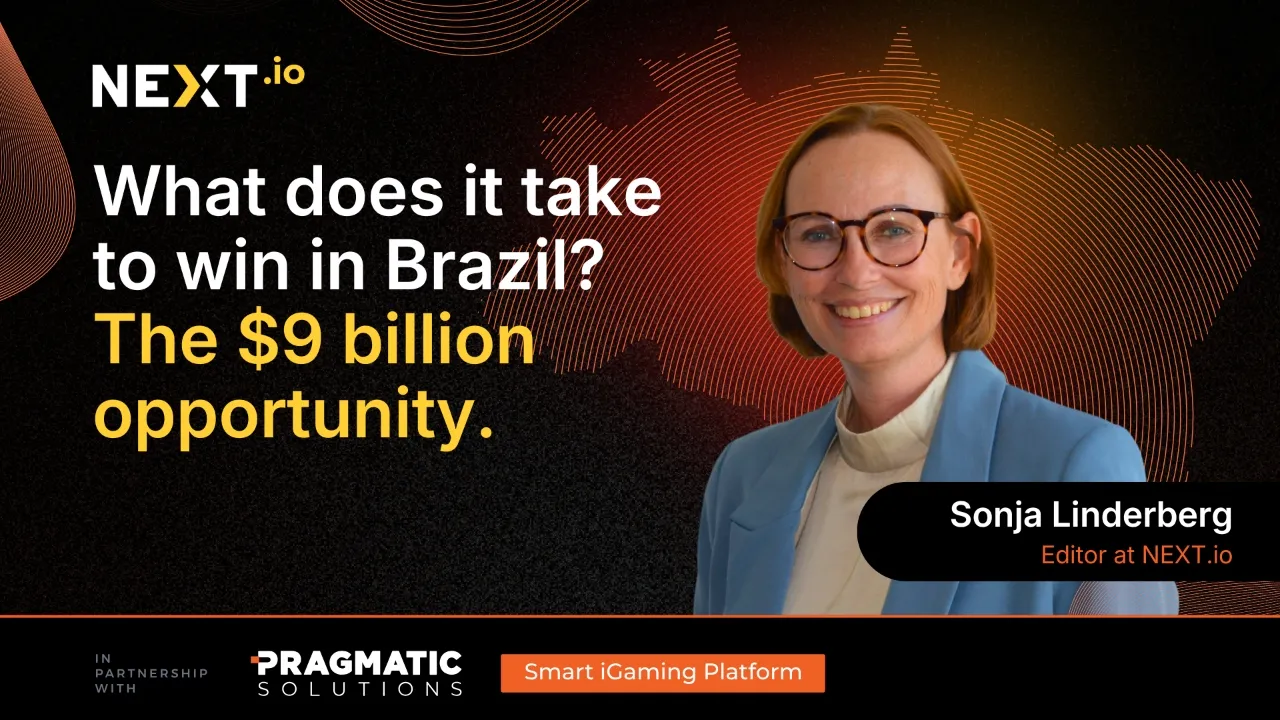
On 17 September 2026, Pragmatic Solutions and NEXT.io brought together an expert panel to discuss the Brazil iGaming Market Report 2026 and what has changed since it was published. Here is what stood out.
Brazil’s regulated iGaming market is nearly two years old, and it has developed faster than experts expected. To make sense of where it stands, and where it is heading through October's general election, we hosted a webinar with NEXT.io alongside a panel covering the commercial, legal, investment and retention sides of the market.
Hosted by Sonja Lindenberg, lead researcher at NEXT.io and author of the report, the webinar panel featured:
- Ashley Lang, CEO of Pragmatic Solutions
- Ramiro Atucha, CEO of Atucha Strategic Advisory
- Neil Montgomery, Founding and Managing Partner at Montgomery
- Muriel Le Senechal, Regional Commercial Manager, LatAm at Fast Track
- Crispin Nieboer, Partner at Tekkorp Capital LLC
The picture that emerged was rather measured.
Brazil has matured at speed, and the prize is substantial: the report projects the licensed market growing towards a $9 billion opportunity by 2029. It is, however, facing a serious near-term test: the prospect of a government move to restrict or ban online casino in the run-up to the election.
The panel's mood was best described as soberly bullish, positive on the medium term, clear-eyed about the risk immediately ahead, and united on one point: the operators that prepare now will be best placed for whatever comes. These were the main takeaways.
How has Brazil's regulated iGaming market performed?
Strongly, and quickly. In its first year, more than 25 million people placed a bet on a licensed platform in Brazil, and the market beat the government's own revenue forecast by close to 20 percent. Regulation, product and player behaviour have all evolved at pace.
Ashley Lang's key point was that this speed changes what it takes to succeed. Because the market has moved so quickly, he argued, it rewards operators that entered with the right foundations in place and retain the agility to respond to whatever comes next.
That readiness has to extend across the whole business: compliance, technology, marketing and the right people, working together. The operators pulling ahead were, quite simply, the best prepared.
What is the outlook for Brazil’s iGaming market in 2026?
The regulated market has beaten its forecasts, yet its direction from here is still uncertain. Ramiro Atucha noted that the regulated market has continued to grow beyond projections, helped by a population that has taken to the product and by the fact that new brands have been able to win share without a long history behind them. Brazilians, he observed, have been more open to new products than players in many other markets.
NEXT.io framed the outlook as two possible futures.

In the bull case, per-capita spend climbs as players mature (Brazilians spend roughly 50 dollars per adult against about 300 in the UK, so there is room to grow), new verticals are regulated over time, and the market moves towards 9 to 12 billion US dollars by the end of the decade.
In the bear case, tighter rules, rising costs and political pressure make the licensed market less competitive against the black market, investment stalls, and growth flattens. That second case no longer feels abstract.
The hinge between the two is the election, with the first round on 4 October and a potential runoff on the 25th, and the political pressure on the sector has been building rather than easing.
Why is Brazil's iGaming market consolidating?
Consolidation is less a risk to the market than a feature built into its design.
Crispin Nieboer made the case that the fixed costs of participating, paid-in capital, licence fees, an all-in tax burden of around 42 percent of GGR, and a demanding compliance stack, cost much the same whether an operator is third or fortieth, which rewards scale.
At the same time, the older, acquisition-heavy growth model has become harder and more expensive, so the advantage now sits with operators that have capital, brand and real retention capability.
For investors, he pointed to the picks and shovels of the market, payments, KYC, integrity and retention technology, as the areas where regulatory tightening acts as a tailwind, because every new requirement increases demand for those services.
How retention and localisation are critical to compete in Brazil’s iGaming Market
With acquisition harder and more expensive, retention is where the next phase will be won. Muriel Le Senechal put it simply: acquisition gets the player in, and CRM determines what happens next. The operators that keep their World Cup sign-ups are the ones that moved quickly from acquisition to understanding behaviour, using real-time segmentation and the value of each player to build personalised journeys.
Muriel was candid about the tension, that it is hard to plan for keeping players when operators do not yet know whether they will be allowed to operate, but she argued that the uncertainty makes retention more important, especially as acquisition costs rise.
She was also clear that Brazil is not one audience. Real localisation means understanding how players behave region by region, supported by reliable attribution, rather than translating the same campaign into Portuguese.
Ramiro Atucha made a related point on marketing: with acquisition costs rising, attribution and product differentiation matter more than raw spend, and compliance mistakes are becoming more expensive.
On innovation, the panel saw room to make the sportsbook feel as fast and engaging as casino, through micro-betting and gamified in-play, provided it stays grounded in real betting on real events.
Will Brazil ban online casino?
This is the biggest near-term question, and the honest answer is that it is not yet settled. Neil Montgomery pointed to reports that the government could issue a provisional measure to restrict or ban online casino, possibly before the first round of the election on 4 October, with sports betting spared. Because casino accounts for the bulk of licensed operators' revenue, in some cases most of it, the potential impact would be significant.
Montgomery was careful to set out the counterweights. A provisional measure would not be the final word: it carries a validity of 60 plus 60 days and ultimately needs the approval of Congress, which passed the 2018 and 2023 laws and may not support a ban if it judges that the current rules already protect players. Any such measure would also likely end up before the Supreme Court. Even so, he was clear that if it comes, the sector should prepare for a difficult period.
Set against that near-term risk are some more constructive signals: a strong regulatory framework built in a short space of time, an active and credible regulator in the SPA, tighter enforcement that is helping to bring the illegal market down from last year's levels, and a fast-track licence created for next year's women's World Cup.
Underpinning the discussion was a shared view that Brazilians will continue to play regardless, which makes a competitive, well-run regulated market the best way to protect both players and the tax base, an argument that cuts against a ban.
On responsible gambling, the panel felt the regulated sector is heading in the right direction, that most of the problems reported publicly sit on the unregulated side, and that the industry needs to make that distinction far better known. Technology, increasingly supported by AI, has a central role in detecting problem-gambling markers, enforcing deposit limits and protecting at-risk players.
How Pragmatic Solutions supports operators in Brazil
Much of the webinar came back to a single point: the operational demands of Brazil run through the platform an operator builds on, and that matters most when the ground is shifting. In the industry, that core is the Player Account Management (PAM) platform, the system that runs player accounts, wallets, transactions and the rules that govern them. It is the environment we designed our platform for, and where we have worked since the market opened in January 2025.
In practice, that means compliance built into the platform, with GLI, ISO 27001 and PCI certification, local representation and local tax status already in place, so operators inherit regulatory readiness rather than rebuilding it.
It means integrating cleanly with Brazil's Pix-based payment providers and processing reliably through the demand peaks the football calendar creates. And it means an open, configurable platform: a decoupled front end that lets operators localise and run several brands at their own pace, open integrations to the CRM and analytics tools they choose, and the flexibility to adapt quickly as the rules change and to migrate and consolidate as the market does.
As Ashley put it during the session, the advantage goes to those who can respond, and technology is a large part of what makes that response possible.
Looking ahead
Brazil's next few months will be shaped by the election and what follows it. The opportunity is real, and so is the uncertainty. As the panel agreed, the operators that prepare now, across compliance, technology, marketing and product, will be the ones best placed to navigate what comes next.
We covered the report's headline findings in Brazil iGaming Market Report 2026: The $9 Billion Opportunity. The full report, produced by NEXT.io in partnership with Pragmatic Solutions, is free to download in English and Portuguese, and remains one of the most detailed independent views of where this market stands and where it could go.
Read other posts

News

Press Release

Press Release